
The格局巨变 means a significant change in the pattern, so it should be translated comprehensively. 'The
According to the latest data from the China Passenger Car Association, the total sales volume of passenger cars in China is expected to exceed 11 million units in 2025, achieving a year-on-year growth of approximately 5.3%. During this year, the market landscape will undergo a fundamental shift, with new energy vehicles dominating the top sales charts, and domestic brands achieving a comprehensive breakthrough.
Overall Market Performance
From January to November 2025, China's passenger vehicle retail sales reached 21.464 million units, a significant year-on-year increase of 29%. Among them, sedan retail sales reached 9.829 million units, accounting for 49.8% of total sales. Based on the pattern that December sales typically increase by 20% compared to November, it is estimated that sedan sales for the whole of 2025 will reach approximately 11.04 million units.
New energy vehicles are leading the way.
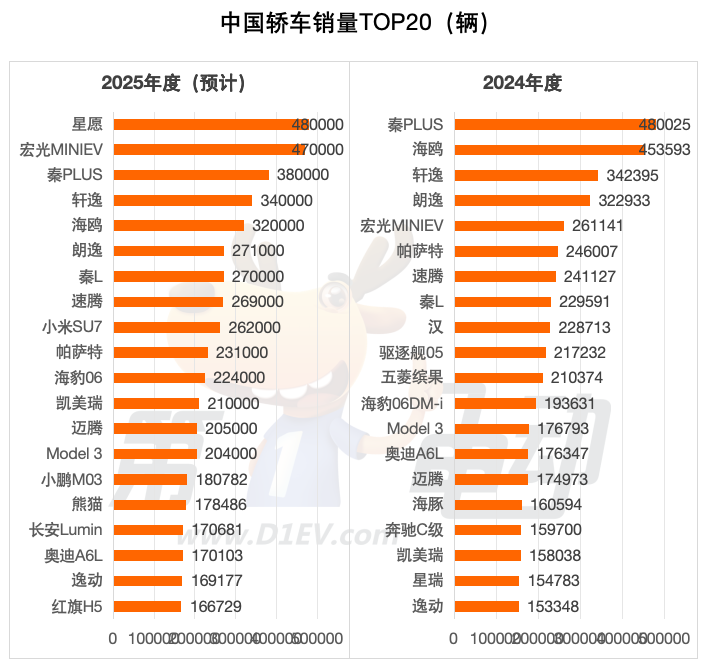
The most significant feature of the 2025 sedan sales rankings is the comprehensive rise of new energy vehicles. New energy sedans occupy 11 of the top 20 spots, with total sales reaching 3.14 million units, accounting for 61% of the total sales of the top 20, a year-on-year increase of 6 percentage points.
Geely Xingyuan topped the sales charts with approximately 480,000 units sold annually, representing a year-on-year increase of 812%, making it the biggest dark horse of the year. This small pure electric sedan, priced between 68,800 and 98,800 yuan, precisely meets the needs of urban commuting and family upgrade markets with its practical range of 401km and personalized design.
The Wuling Hongguang MINIEV ranked second with sales of approximately 470,000 units, maintaining its dominance in the micro pure electric vehicle market with an 80% year-on-year increase. These two models together solidified the leading position of new energy vehicles at the top of the list.
Emerging brands also performed impressively. The Xiaomi SU7 ranked ninth with approximately 262,000 units sold, its 88% year-on-year increase propelling it into the top ranks of C-segment sedan sales. The XPeng M03, with an astonishing 273% increase, ranked fifteenth, its starting price of 119,800 yuan facilitating the widespread adoption of intelligent driving features.
The Perseverance and Challenges of Joint Venture Brands
Traditional gasoline-powered vehicles are expected to maintain a "structural holdout" in 2025, with joint venture brands being the core support for this trend. Among the top 20 gasoline-powered vehicles, joint venture brands occupy 7 spots, but their total sales volume is approximately 1.69 million units, a year-on-year decrease of 7 percentage points.
The compact segment remains a stronghold for joint venture gasoline-powered vehicles. The Nissan Sylphy ranked fourth with approximately 340,000 units sold, becoming the only gasoline-powered model to surpass the 300,000-unit mark. SAIC Volkswagen Lavida and FAW-Volkswagen Sagitar ranked sixth and eighth with approximately 271,000 and 269,000 units sold respectively.
In the mid-size car market, the Toyota Camry performed exceptionally well, ranking twelfth with approximately 210,000 units sold. Its 33% year-on-year increase made it the fastest-growing model among joint venture gasoline vehicles. Its success can be attributed to the improved thermal efficiency of its THS hybrid system to 41%, and its market strategy of lowering the starting price to 131,800 yuan.
In the luxury gasoline car segment, only the Audi A6L remains on the list among the BBA brands, ranking 18th with sales of approximately 170,000 units.
Annual Comparison: Profound Restructuring of the Market Landscape
Compared to 2024, the sedan market rankings saw significant changes in 2025. The 2024 sales champion, the Qin PLUS, slipped to third place in 2025, while the Hongguang MINIEV, which ranked fifth last year, jumped to second. The Xiaomi SU7 became the first model from a new energy vehicle brand to enter the top ten in annual sales.

Joint venture brands as a whole are experiencing "collective pressure and shrinking market share." The top three best-selling joint venture models in 2024—the Nissan Sylphy, Volkswagen Lavida, and Volkswagen Passat—all saw their rankings decline in 2025. Among luxury joint venture brands, the Mercedes-Benz C-Class fell out of the top 20, and the Audi A6L also saw a drop in ranking.
Industry Trends and Application Prospects of Pneumatic Components
This market shift has a profound impact on the automotive manufacturing supply chain. With the rise of domestically produced new energy vehicles, the demand for high-performance pneumatic components from domestic automakers continues to grow. In automated production lines, assembly machinery, and testing equipment, FDS pneumatic components, with their high reliability and precision, are being widely used in the manufacturing process of new energy vehicles.
Especially in key processes such as battery pack assembly, motor assembly, and body welding, high-performance pneumatic components ensure production efficiency and product quality. As the automotive industry transforms towards electrification and intelligence, the technical requirements for pneumatic components are constantly increasing, including higher response speed, lower energy consumption, and stronger environmental adaptability.
Looking ahead to 2026
With the continued strong sales of new models such as the Seal 05DM-i, Bingo S, and Jihu T1, and the implementation of the policy to reduce purchase tax incentives for electric vehicles, the sedan market will usher in a new round of reshuffling in 2026. For pneumatic component suppliers, keeping up with the technological changes in the automotive industry and developing products that meet the manufacturing needs of new energy vehicles will be key to seizing market opportunities.